Posts

Lebanese Personal Status Laws II

Image
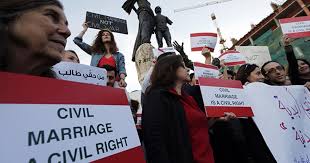
Interview with Women’s Rights Activist Caroline  Succar   S a libi :   Women are not treated  equally  in Lebanese family court s, prospects for an optional modern civil family law are dim   Last  Ju ne I  telephonically  interviewed Lebanese women’s  rights advocate , Caroline  Succar   Salibi , about the treatment of Lebanese women in Family courts.    Ms   Salibi  has done extensive work on Lebanese women’s rights issues and is recognized as an expert in the field.  Below are  edited  excerpts  of the interview :     - How are women treated in  Lebanese family courts? Unequally. The way they are treated many times denies them their humanity. Many women who leave their husbands due to violence often say that the legal violence the system imposes on them is worse than the mental and physical violence they faced from their abusive husbands. ...
Lebanese Law and Women’s rights- I

Image
Lebanese Law and Women’s rights- I The issue of Lebanese law and women often comes up in American courts in matters involving Lebanese American litigants. A review of material published by the Lebanese Women Democratic Gathering* and Human Rights Watch** helps shed light on important questions. Below are commonly asked questions and their answers. 1. Is Lebanon a Muslim country? Lebanon is a Muslim- majority- country. About 30% Shia, 30% Sunni and 30% Christian and 10% other minorities such as the Druze.  Demographically, Lebanon is a Muslim country. The Christians dispute these numbers arguing that counting all the Lebanese in the diaspora makes Lebanon a Christian- majority country. But fact is, as to those Lebanese living in Lebanon that have Lebanon as the place of their habitual residence, the majority are Muslims. 2. Is Lebanon then just like Saudi Arabia or Jordan as to its being a Muslim country? Lebanon is a Republic. It is not a...

Interview with Imad Hamad, American Human Rights Council Executive Director

Image
The American Human Rights Council (AHRC) is holding its annual banquet on Thursday May 18. I interviewed Mr. Imad Hamad with questions about the banquet and about AHRC. Below are excerpts. Q: Another year, another banquet. What are the highlights of this year’s banquet? A: This year we are having our third banquet. We are awarding remarkable individuals from diverse backgrounds for their work advancing human rights. We expect a strong turnout, a full house- just like last year. Last year we had over 800 attendees. This year we have a special guest whose appearance is a great honor for the banquet. Q: Human rights is a new type of advocacy in Arab and Muslim circles, does this present a challenge to AHRC? A: It used to present a serious challenge. Before AHRC, I advocated for years for civil rights and civil liberties, locally, nationally and internationally. Advocacy for civil rights and liberties has been around for so many years that almost eve...

The Syrian conflict and Hezbollah: Are there winners in the Syrian conflict?

Image
The Syrian conflict and Hezbollah: Are there winners in the Syrian conflict?* The Wall Street Journal is one of America’s finest papers. It is also the paper with the biggest paid circulation. Even those who are liberal and not fond of its editorial policies have to admit that the reporting is professional, objective and accurate. There is a so-called Chinese wall between editorial writing and news writing. Inaccurate and Unbalanced On the Middle East, the Journal has good writers that have written deep and incisive pieces on the region. Understandably, Syria and Iraq get the bulk of the attention in Middle East reporting. One of the Journal’s reporters in the region is Maria Abi Habib. Recently, she wrote a piece on the Syrian conflict. Her thesis was that Hezbollah is the winner in the Syrian conflict. It seemed as if it was written by Hezbollah's PR department to raise the morale of its fighters and its core constituency. The page one article by ...

Israel and the ESCWA report

Image
Israel and the ESCWA report: The case of the Israeli crime of apartheid in Palestine The single most important document on Palestine today* Professor Virginia  Tilley Professor Richard Falk The honorable Rima Khalaf resigned from her position as the Executive Secretary of the United Nations Economic and Social Commission for Western Asia (ESCWA) amid a controversy about a report published by ESCWA. Ms Khalaf held her position at the UN from 2010 to 2017. She decided to resign rather than remove the report as ordered by the Secretary General of the UN António Guterres. The report made Israel and its supporters angry, and for good reasons. The report cost Khalaf her job, its removal “earned” Guterres another term at the UN. The report, Israeli Practices towards the Palestinian People and the Question of Apartheid, is a relatively short document- 65 pages only. But it is the single most important document on Palestine today. In this document, the a...